TactDeform
Finger Pad Deformation Inspired Spatial Tactile Feedback
for Virtual Geometry Exploration
Yihao Dong · Praneeth Perera · Chin-Teng Lin · Craig Jin · Anusha Withana
Overview
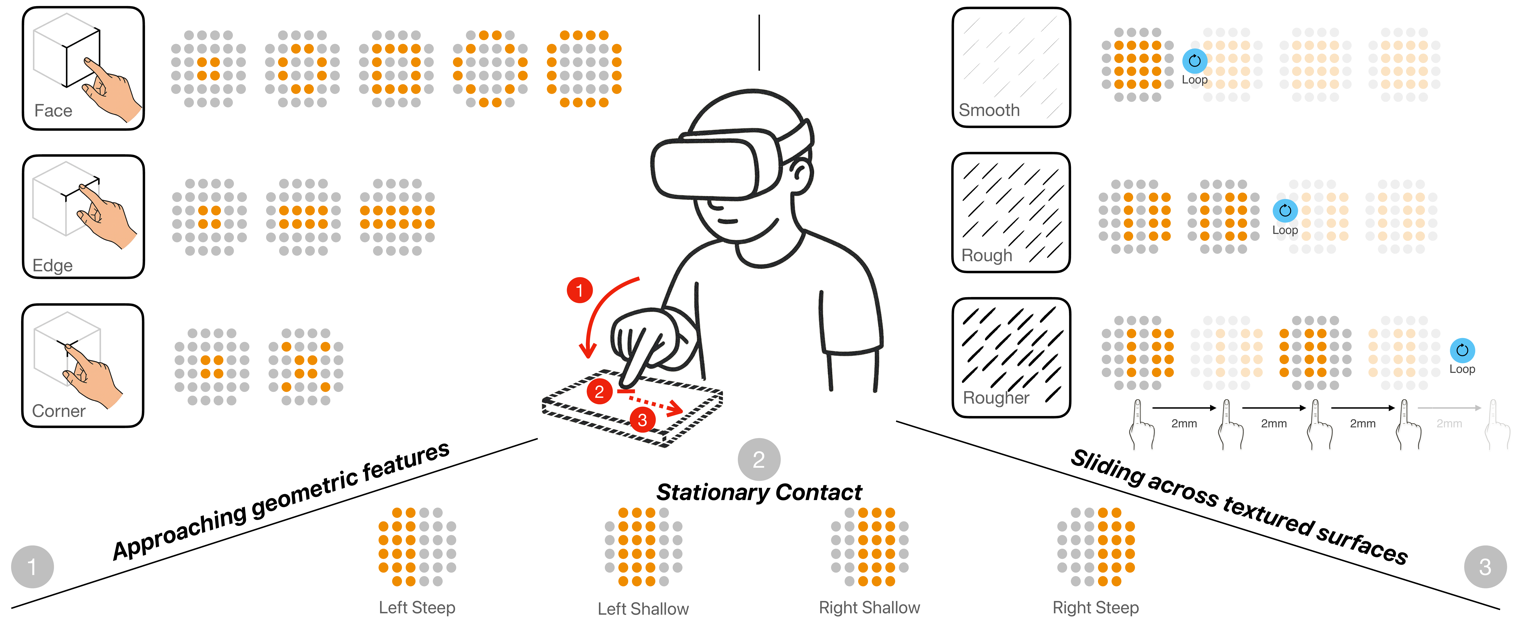
TactDeform is a parametric approach to rendering spatio-temporal tactile patterns using a finger-worn electro-tactile interface for virtual reality. Inspired by how our finger pads naturally deform when touching real-world 3D objects, TactDeform dynamically adapts electro-tactile stimulation based on both interaction contexts (approaching, contact, sliding) and geometric contexts (features and textures).
When we explore physical objects, our fingertips deform in characteristic ways, spreading across flat surfaces, concentrating along edges, pressing into corners. TactDeform brings this natural tactile understanding into VR, enabling users to feel the geometry of virtual objects through a lightweight wearable array, without bulky force-feedback hardware.
How It Works
A dual-context approach generates parametric spatio-temporal electro-tactile patterns via a 32-electrode finger-worn array.
Interaction Contexts
Approaching
Expanding patterns emulate progressive deformation as the finger nears a surface, modulated by approach velocity.
Stationary Contact
Orientation-specific patterns adapt to the finger's angle, emulating pressure distribution across pad regions.
Sliding
Dynamic pattern shifts emulate friction-induced deformations, modulated by roughness and movement velocity.
Geometric Features
Faces
Planar surfaces produce diverging ring patterns expanding outward from the contact centre.
Edges
Linear features create directional line patterns extending from the contact centre along the edge axis.
Corners
Point features concentrate stimulation at the array centre with parametric falloff.
Textures
Smooth
Slow, wide pattern shifts during sliding convey a low-friction smooth surface.
Rough
Faster, more frequent pattern shifts render a mid-level textured surface.
Rougher
Larger shifts deliver a coarse, highly textured surface sensation.



Resources
BibTeX
@inproceedings{dong2026tactdeform,
  title     = {TactDeform: Finger Pad Deformation Inspired Spatial Tactile Feedback
               for Virtual Geometry Exploration},
  author    = {Dong, Yihao and Perera, Praneeth Bimsara and Lin, Chin-Teng
               and Jin, Craig and Withana, Anusha},
  booktitle = {Proceedings of the 2026 CHI Conference on Human Factors
               in Computing Systems},
  year      = {2026},
  doi       = {10.1145/3772318.3791699}
}